
Teeth Whitening UK Law: The 0.1% Limit Most People Don't Know
Teeth whitening legal UK rules are simpler than most people think — but many products sold online break them. Teeth whitening is legal in the UK, as long as the product meets strict limits, and many sold online don't. Here's what UK law actually says, why it matters for your safety, and how to make sure the product you buy is legal.
The teeth whitening legal UK limit: 0.1% peroxide
UK law sets a clear limit on how much peroxide a teeth whitening product sold to the public can contain. Under the Cosmetic Products Enforcement Regulations 2013, retailers — including shops, beauticians and online sellers — can only supply whitening products that contain or release 0.1% hydrogen peroxide or less.
Above that, the rules tighten sharply:
0.1% to 6% peroxide — can only be supplied by a dentist or GDC-registered dental professional, who must oversee the first use.
More than 6% peroxide — illegal for cosmetic whitening in the UK.
The penalty for selling non-compliant products is significant: fines of up to £20,000.
Why so many products you see online are illegal
Here's the problem most shoppers never realise: a product can be sold openly online — often shipped from overseas — and still be far over the UK legal limit. The numbers don't sound alarming unless you know the rule.
Take a kit advertised as "35% carbamide peroxide." Carbamide peroxide releases roughly a third of its weight as hydrogen peroxide, so 35% carbamide peroxide releases around 12% hydrogen peroxide once used — about 120 times the legal limit for sale to the public.
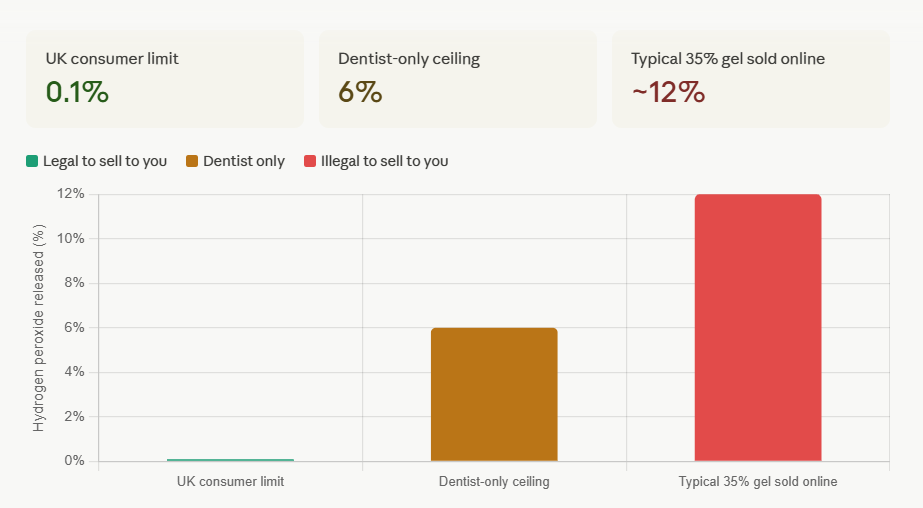
In late 2025, a BBC investigation tested products being sold to the public and found some containing hydrogen peroxide levels as high as 53%. The British Dental Association warned these were being sold at many times the concentration even dentists are legally allowed to use, with real cases of burns, severe sensitivity and tooth loss.
How to check if a whitening product is legal
You don't need to be an expert. A few quick checks tell you most of what you need:
Look for the peroxide content. If it states more than 0.1% hydrogen peroxide — or any percentage of carbamide peroxide above roughly 0.3% — it's over the consumer limit.
Be cautious of "35% CP," "professional strength," or "extreme" claims. Strong-sounding numbers are a warning sign, not a selling point.
Consider peroxide-free formulas. Ingredients like PAP (phthalimidoperoxycaproic acid) and sodium percarbonate are designed to whiten without exceeding peroxide limits, which is why they're popular for home use in the UK.
Check where it ships from. Products shipped direct from overseas sellers may not meet UK rules, even when listed in pounds.
Whitening products that meet UK rules
At The White Choice, every product we list has been checked to meet the UK 0.1% limit — peroxide-free, or within the legal threshold. We do the label-reading so you don't have to.
Browse our checked comparisons:
The bottom line
Teeth whitening is perfectly legal in the UK when you use a compliant product. The risk comes from the products that aren't — and because most shoppers don't know the 0.1% rule, those products keep selling. Knowing the limit is the single best protection you have. Check the label, choose a compliant product, and whiten with confidence.
It's worth knowing why this matters: the 0.1% limit exists because higher concentrations can burn gums, damage enamel and cause lasting sensitivity. That's why the products we list are checked against it — so you can whiten at home with the reassurance that what you're using is within the law. Browse our compliant comparisons above to find the right option for you.